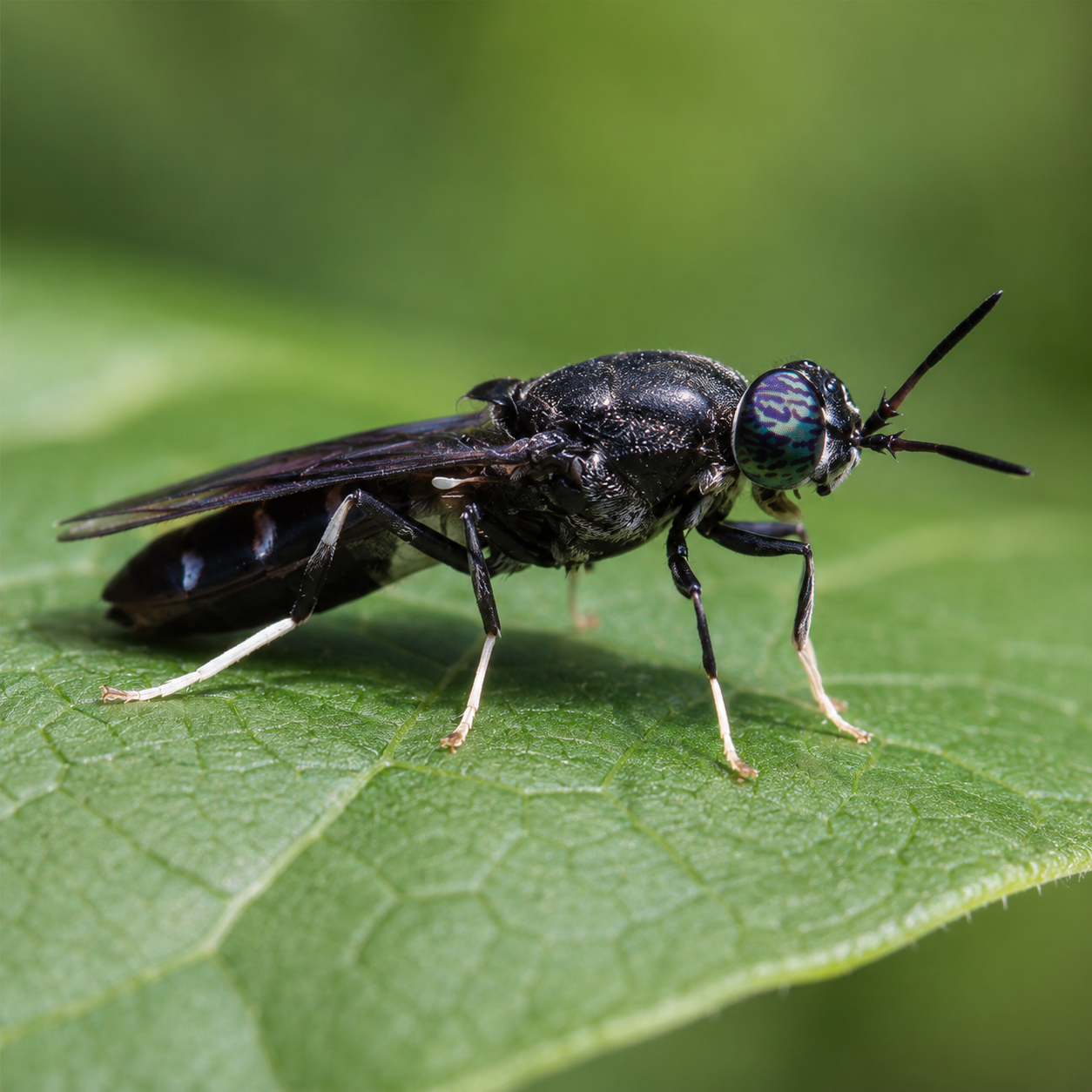
Black Soldier Fly
The Black Soldier Fly (Hermetia illucens) is a species of fly native to the Americas and now found worldwide in tropical and temperate regions. It is recognized for its ecological and economic value, especially in waste management and sustainable protein production.
Key facts
- Scientific name: Hermetia illucens
- Family: Stratiomyidae (soldier flies)
- Native range: Americas; now cosmopolitan
- Lifespan: 6–8 weeks (adult stage lasts about 5–8 days)
- Primary uses: Waste reduction, animal feed, organic fertilizer
Life cycle and biology
The Black Soldier Fly undergoes complete metamorphosis—egg, larva, pupa, and adult. Females lay hundreds of eggs near decaying organic matter. The larvae, robust and voracious, consume food waste, manure, and agricultural by-products, converting them into protein and fat-rich biomass. Adults do not feed; they rely on fat reserves accumulated during the larval stage.
Ecological and economic significance
The larvae are used for bioconversion of organic waste, reducing waste volume by up to 70%. Their frass (residual compost) serves as a nutrient-rich soil amendment. Dried larvae or processed meal are increasingly used as sustainable feed for poultry, fish, and pets, providing an alternative to fishmeal and soy protein.
Industrial and environmental applications
Black Soldier Fly cultivation supports circular bioeconomy models. Farms rear larvae on food or agricultural waste, producing protein meal, oils, and fertilizer. The process contributes to greenhouse gas mitigation and landfill diversion. It is widely adopted in countries such as China, South Africa, and the Netherlands.
Research and regulation
Ongoing research explores Black Soldier Fly genetics, gut microbiota, and optimal rearing conditions. Regulatory frameworks—especially in the European Union and North America—are evolving to govern insect-based feeds and ensure safety for livestock and aquaculture use.
Black Soldier Fly (BSF) Quiz Questions and Answers
1. What is the scientific name of the Black Soldier Fly?
Answer: Hermetia illucens
2. Why is the Black Soldier Fly important in maggot farming?
Answer: It produces larvae that are rich in protein and can be used as livestock feed.
3. Which stage of the BSF life cycle is commonly harvested for animal feed?
Answer: Larval stage.
4. What do BSF larvae primarily feed on?
Answer: Organic waste materials such as food scraps, fruit waste, manure, and agricultural by-products.
5. Name the four main stages in the life cycle of a Black Soldier Fly.
Answer: Egg, larva, pupa, and adult.
6. How does BSF farming help the environment?
Answer: It reduces organic waste and converts it into useful protein and fertilizer.
7. Which nutrients make BSF larvae valuable as livestock feed?
Answer: Protein, fat, amino acids, vitamins, and minerals.
8. What is the dark-colored stage that occurs before the adult fly emerges?
Answer: Pupal stage.
9. Why are adult Black Soldier Flies considered less of a nuisance than houseflies?
Answer: They do not bite, sting, or spread diseases through feeding on human food.
10. Besides livestock feed, what other useful product is obtained from BSF farming?
Answer: Organic fertilizer (frass).
Critical Thinking Questions
1. Why can BSF farming reduce the cost of poultry production?
Answer: Because BSF larvae provide a cheaper source of protein than commercial feed ingredients.
2. What would happen if BSF larvae were not supplied with enough organic waste?
Answer: Their growth and development would be reduced.
3. Why should a farmer harvest larvae before they become pupae?
Answer: Because larvae contain the highest nutritional value for animal feed.
4. How can BSF farming contribute to sustainable agriculture?
Answer: By recycling waste into animal feed and fertilizer.
5. Why is proper moisture management important in a BSF larval bed?
Answer: Excessive or insufficient moisture can affect larval growth and survival.
6. What advantage does BSF farming have over disposing of organic waste in landfills?
Answer: It converts waste into useful products instead of creating pollution.
7. Why is it beneficial for fish farmers to include BSF larvae in fish diets?
Answer: The larvae provide high-quality protein needed for growth.
8. How would poor hygiene affect a maggot farming operation?
Answer: It may attract pests, create odors, and reduce productivity.
9. Why are BSF larvae called biological waste converters?
Answer: Because they transform waste materials into protein-rich biomass.
10. How can a farmer increase BSF egg production?
Answer: By providing suitable breeding conditions, adequate light, and proper egg-laying sites.