Introduction
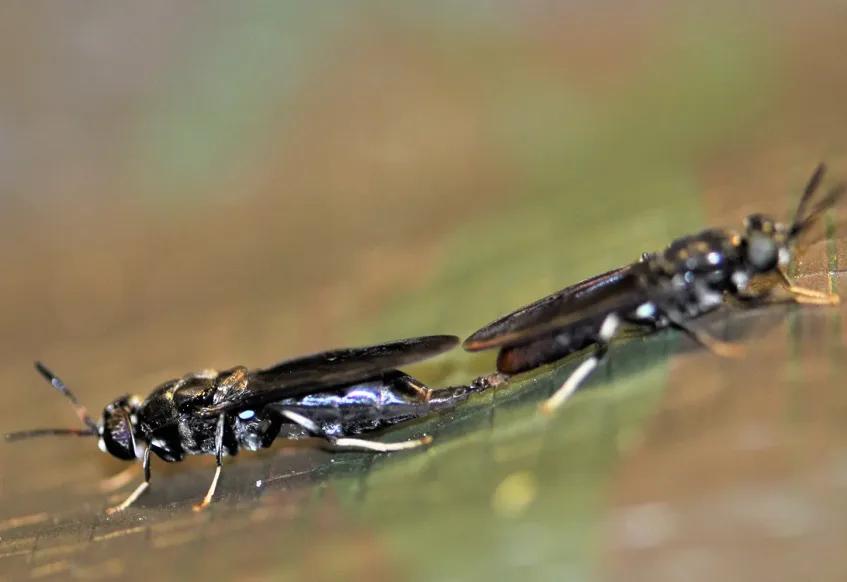
The reproductive biology of the Black Soldier Fly (BSF), Hermetia illucens, is a critical aspect of successful BSF farming. Understanding how BSF adults mate, lay eggs, and produce offspring enables farmers to maintain healthy breeding colonies and achieve continuous larval production. Unlike many insects, adult BSF do not feed and dedicate their short lifespan primarily to reproduction.
Sexual Maturity


Adult BSF emerge from the pupal stage fully developed and become sexually mature within a few days.
Male BSF
- Mature slightly earlier than females.
- Search actively for mates.
- Use visual cues and sunlight to locate females.
Female BSF
- Become receptive shortly after emergence.
- Mate only once or a few times during their lifespan.
- Store sperm for egg fertilization.
Courtship and Mating Behavior
Mating usually occurs:
- During daylight hours.
- In warm temperatures.
- Under adequate light intensity.
- In open spaces with good air circulation.
Male flies establish territories and compete for access to females. Once a female is located, mating occurs and may last several minutes.
Factors Affecting Mating Success
- Sunlight or artificial lighting
- Temperature (27–35°C)
- Relative humidity (60–80%)
- Adequate breeding space
- Healthy adult population
Egg Production


After mating, females search for suitable egg-laying sites near decomposing organic matter.
Egg-Laying (Oviposition)
Females prefer:
- Dry cracks and crevices
- Corrugated cardboard
- Wooden slats
- Bamboo strips
They avoid laying eggs directly on wet waste.
Egg Production Capacity
A healthy female can lay:
- 500–900 eggs per batch
- Occasionally over 1,000 eggs under ideal conditions
The eggs are:
- Cream-colored
- Oval-shaped
- About 1 mm long
Egg Development
After laying, eggs undergo embryonic development.
Conditions Required
- Warm temperatures
- Moderate humidity
- Protection from predators
Incubation Period
- Typically 3–4 days
- May vary depending on environmental conditions
Once hatched, larvae immediately begin feeding on nearby organic material.
Factors Influencing Reproduction
Light
BSF require adequate light for successful mating.
Sources may include:
- Natural sunlight
- Greenhouse lighting
- Specialized artificial breeding lights
Temperature
Optimal reproductive performance occurs between:
- 27°C and 35°C
Low temperatures reduce mating activity and egg production.
Humidity
Relative humidity between:
- 60% and 80%
supports egg viability and adult activity.
Nutrition During Larval Stage
Because adults do not feed, reproductive success depends largely on nutrients accumulated during the larval stage.
Well-fed larvae produce:
- Larger adults
- Higher mating success
- Greater egg production
Reproductive Cycle Summary


| StageDurationActivity | ||
| Adult Emergence | Day 1 | Adult exits pupa |
| Sexual Maturity | 1–3 days | Mating readiness |
| Mating | Day 2–5 | Fertilization |
| Egg Laying | Day 3–8 | Oviposition |
| Egg Incubation | 3–4 days | Embryonic development |
| Larval Hatch | Day 4–12 | New generation begins |
Importance of Reproductive Biology in BSF Farming
Understanding BSF reproduction helps farmers:
- Maintain continuous egg production.
- Improve colony sustainability.
- Increase larval yields.
- Optimize breeding conditions.
- Improve farm profitability.
Without successful reproduction, larval production and farm productivity decline rapidly.
Critical Thinking Questions
1. Why do adult BSF focus primarily on reproduction?
Answer: Because they do not feed and have a short lifespan dedicated mainly to mating and egg laying.
2. Why is sunlight important for BSF mating?
Answer: Light stimulates mating behavior and helps adults locate mates.
3. Why do female BSF lay eggs near organic waste instead of directly on it?
Answer: To protect eggs from excessive moisture while ensuring larvae have access to food after hatching.
4. How would poor larval nutrition affect adult reproduction?
Answer: Adults would have less stored energy, resulting in reduced mating success and egg production.
5. Why is temperature important in BSF breeding?
Answer: Temperature affects adult activity, mating behavior, and egg development.
6. What could happen if humidity is too low during egg incubation?
Answer: Eggs may dry out and fail to hatch.
7. Why should farmers provide suitable egg-laying materials?
Answer: To encourage females to deposit eggs efficiently and increase collection rates.
8. How can a farmer increase egg production in a BSF colony?
Answer: By providing optimal light, temperature, humidity, breeding space, and healthy larvae.
9. Why is reproduction considered the foundation of BSF farming?
Answer: Because continuous egg production is necessary for continuous larval production.
10. How does understanding reproductive biology improve farm productivity?
Answer: It helps farmers optimize breeding conditions and maximize colony performance.