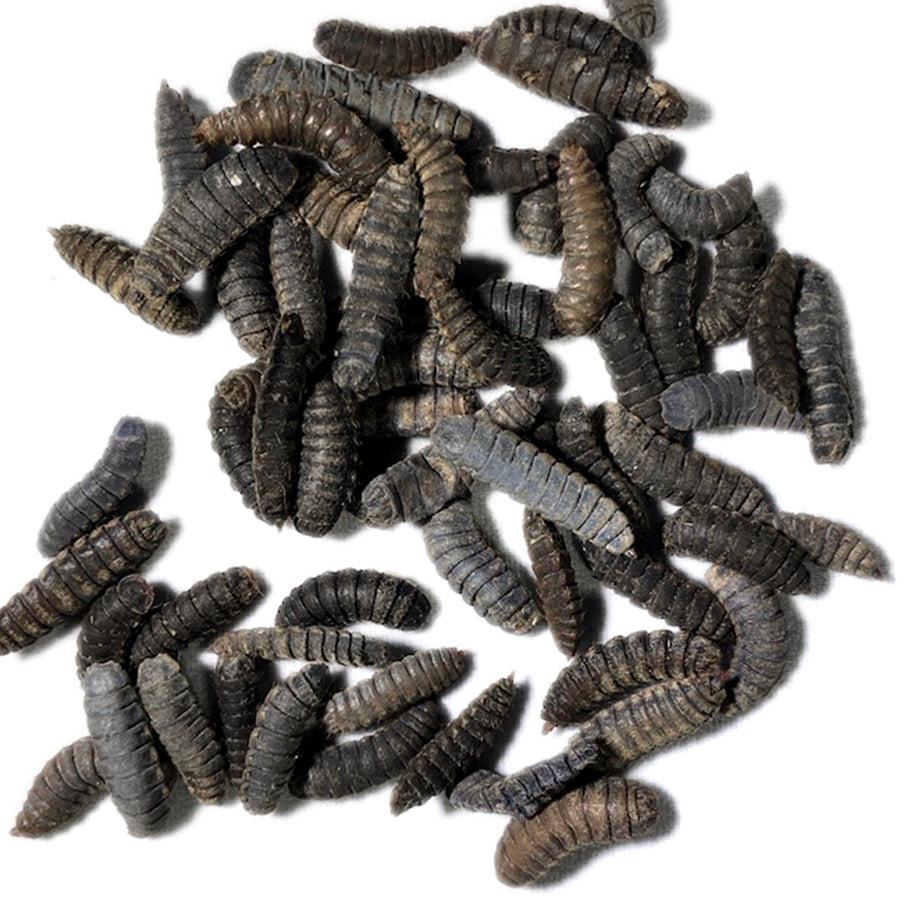
Black Soldier Fly (BSF) Life Cycle and Biology
The Black Soldier Fly (Hermetia illucens) is one of nature's most efficient recyclers. Its ability to convert organic waste into high-protein biomass has made it an important insect in sustainable agriculture and livestock production.
Complete Metamorphosis
The BSF undergoes four distinct stages of development:
1. Egg Stage (3–4 Days)


Female BSF adults lay between 500 and 900 eggs in small cracks and crevices near decaying organic matter. The eggs are tiny, cream-colored, and resemble grains of rice when viewed under magnification.
Key Facts
- Duration: 3–4 days
- Egg size: About 1 mm
- Eggs are laid near, not directly on, wet waste
- One female can lay several hundred eggs
2. Larval Stage (14–18 Days)


The larval stage is the most important phase in BSF farming. The larvae consume food waste, fruit waste, kitchen scraps, manure, and agricultural by-products.
During this period, they:
- Increase their weight by thousands of times
- Convert waste into valuable protein and fat
- Reduce waste volume significantly
- Produce nutrient-rich frass (organic fertilizer)
Nutritional Composition
- Crude Protein: 35–45%
- Fat: 25–35%
- Rich in calcium and essential amino acids
This stage is commonly harvested for poultry, fish, pig, and pet feed.
3. Prepupal and Pupal Stage (10–14 Days)


As larvae mature, they stop feeding and become darker in color. These are called prepupae.
The prepupae:
- Migrate away from food sources
- Seek dry places for pupation
- Develop protective outer coverings
Inside the pupa, the insect undergoes transformation into an adult fly.
Key Facts
- No feeding occurs
- Internal organs are reorganized
- Wings, legs, and reproductive organs develop
4. Adult Stage (5–8 Days)


Adult Black Soldier Flies emerge from the pupae and focus solely on reproduction.
Unlike houseflies:
- They do not bite
- They do not sting
- They do not transmit diseases through feeding
- They rarely enter homes
Adult BSFs do not eat because they have non-functional mouthparts. They survive on fat reserves accumulated during the larval stage.
Their primary activities are:
- Mating
- Laying eggs
- Starting a new generation
Life Cycle Summary
| StageDurationMain Activity | ||
| Egg | 3–4 days | Development and hatching |
| Larva | 14–18 days | Feeding and growth |
| Pupa | 10–14 days | Metamorphosis |
| Adult | 5–8 days | Mating and egg laying |
Why BSF is Important
✅ Converts waste into valuable protein
✅ Produces sustainable livestock feed
✅ Reduces environmental pollution
✅ Produces organic fertilizer (frass)
✅ Supports poultry, fish, piggery, and livestock farming
For every kilogram of organic waste consumed, BSF larvae can produce significant amounts of protein-rich biomass, making them a cornerstone of modern insect farming and circular agriculture.
Critical Thinking Questions on the Life Cycle and Biology of the Black Soldier Fly (BSF)
1. Why is the larval stage considered the most important stage in BSF farming?
Answer: Because the larvae consume waste rapidly and produce protein-rich biomass used as animal feed.
2. Why do female BSF adults lay their eggs near organic waste instead of directly on it?
Answer: To protect the eggs from excessive moisture, predators, and contamination while ensuring newly hatched larvae have immediate access to food.
3. How would a shortage of organic waste affect BSF larval development?
Answer: Larvae would have insufficient nutrients, resulting in slower growth, smaller size, and lower yields.
4. Why are BSF adults able to survive without feeding?
Answer: They rely on fat reserves accumulated during the larval stage for energy.
5. How does the pupal stage demonstrate the concept of complete metamorphosis?
Answer: The insect undergoes a complete transformation from a larva into a winged adult with different structures and functions.
6. Why is harvesting BSF larvae before they enter the pupal stage often more beneficial for livestock feed production?
Answer: Because larvae contain higher levels of protein and fat than pupae or adults.
7. How does BSF farming contribute to environmental sustainability?
Answer: It recycles organic waste into valuable feed and fertilizer, reducing pollution and landfill waste.
8. Why might a farmer provide cardboard or wooden strips in a BSF breeding unit?
Answer: To create suitable egg-laying sites for female flies.
9. What could happen to a BSF colony if there were very few adult flies available for mating?
Answer: Egg production would decrease, leading to fewer larvae and reduced farm productivity.
10. How does the inability of adult BSF flies to feed influence the management of a BSF breeding facility?
Answer: Farmers must focus on providing proper conditions for mating and egg laying rather than feeding the adults.
Advanced Critical Thinking Questions
11. Why is BSF considered a better waste converter than many other insects?
Answer: Because it can consume large quantities of organic waste quickly and efficiently convert it into valuable biomass.
12. If the larval stage were shortened by poor environmental conditions, how would this affect feed production?
Answer: It would reduce larval size and biomass, lowering feed yield and profitability.
13. Why do BSF larvae thrive in agricultural systems that generate large amounts of organic waste?
Answer: The waste provides a continuous food source that supports rapid larval growth.
14. How could a fish farmer benefit from integrating BSF production with fish farming?
Answer: The farmer can produce a low-cost, high-protein feed source while reducing feed expenses.
15. Why is understanding the BSF life cycle important for successful maggot farming?
Answer: It enables farmers to manage breeding, feeding, harvesting, and colony maintenance at the appropriate stages for maximum productivity.