Introduction
Sustainable agriculture focuses on producing food and other agricultural products in ways that protect the environment, conserve natural resources, and ensure long-term productivity. The Black Soldier Fly (BSF), Hermetia illucens, has emerged as one of the most valuable insects in sustainable agriculture due to its ability to convert organic waste into high-quality animal feed and organic fertilizer.
As global populations grow and the demand for food increases, BSF farming offers an innovative and environmentally friendly solution to many agricultural challenges.
Major Benefits of BSF in Sustainable Agriculture
1. Efficient Organic Waste Recycling


BSF larvae can consume a wide variety of organic materials, including:
- Food scraps
- Fruit and vegetable waste
- Animal manure
- Agricultural by-products
- Brewery waste
By converting waste into valuable biomass, BSF reduces environmental pollution and landfill accumulation.
2. Production of High-Quality Animal Feed


BSF larvae are rich in:
- Protein (35–45%)
- Fat (25–35%)
- Essential amino acids
- Minerals such as calcium and phosphorus
They can be used as feed for:
- Poultry
- Fish
- Pigs
- Pets
This reduces dependence on expensive feed ingredients such as fishmeal and soybean meal.
3. Production of Organic Fertilizer (Frass)


BSF frass is the residue left after larvae digest organic waste.
Benefits include:
- Improved soil fertility
- Increased microbial activity
- Enhanced plant growth
- Improved water retention
- Reduced dependence on chemical fertilizers
4. Reduction of Environmental Pollution
BSF farming helps:
- Reduce food waste
- Minimize greenhouse gas emissions
- Lower odor from waste accumulation
- Reduce contamination of water sources
This contributes to a cleaner and healthier environment.
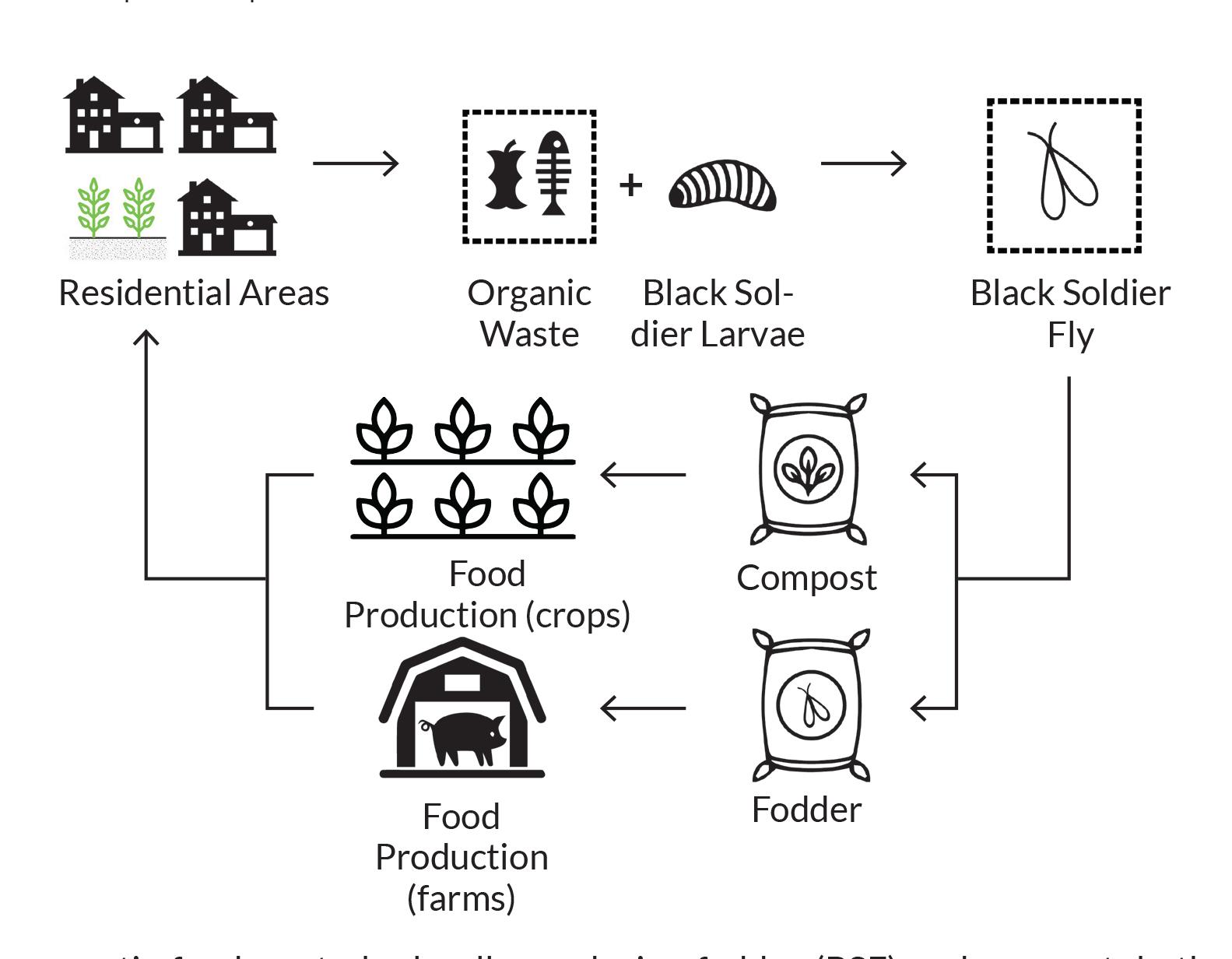
5. Supports Circular Agriculture
BSF farming transforms waste into resources.
Example:
- Kitchen waste → BSF larvae
- BSF larvae → Poultry feed
- Poultry manure → BSF feed substrate
- BSF frass → Crop fertilizer
This creates a sustainable cycle with minimal waste.
6. Conserves Natural Resources
BSF production requires:
- Less land
- Less water
- Less energy
Compared with traditional protein sources, BSF farming has a significantly smaller environmental footprint.
7. Enhances Food Security
By producing affordable livestock feed, BSF farming helps farmers:
- Raise more poultry
- Produce more fish
- Increase pig production
- Reduce feed costs
This contributes to increased food availability and improved nutrition.
8. Creates Economic Opportunities
BSF farming generates income through:
- Sale of fresh larvae
- Sale of dried larvae
- Sale of insect meal
- Sale of frass fertilizer
- Training and consultancy services
It also creates employment opportunities for youth and rural communities.
9. Reduces Pressure on Wild Fish Stocks
Fishmeal production depends heavily on harvesting wild fish.
BSF larvae provide an alternative protein source that:
- Reduces overfishing
- Conserves marine ecosystems
- Supports sustainable aquaculture
10. Promotes Climate-Smart Agriculture
BSF farming supports climate resilience by:
- Recycling nutrients
- Reducing agricultural waste
- Lowering greenhouse gas emissions
- Producing sustainable feed and fertilizer
Summary of Benefits
| BenefitImpact | |
| Waste Recycling | Reduces pollution and landfill waste |
| Animal Feed | Provides affordable protein |
| Organic Fertilizer | Improves soil health |
| Environmental Protection | Reduces emissions and waste |
| Circular Agriculture | Converts waste into resources |
| Resource Conservation | Uses less land and water |
| Food Security | Supports livestock production |
| Job Creation | Generates income and employment |
| Marine Conservation | Reduces dependence on fishmeal |
| Climate Resilience | Supports sustainable farming |
Critical Thinking Questions
1. Why is BSF considered an environmentally friendly agricultural technology?
Answer: It converts waste into useful products while reducing pollution.
2. How can BSF farming help reduce livestock feed costs?
Answer: By providing a cheaper source of protein than conventional feeds.
3. Why is BSF frass valuable to crop farmers?
Answer: It improves soil fertility and plant growth.
4. How does BSF farming support the circular economy?
Answer: It transforms waste into feed and fertilizer that can be reused in agriculture.
5. Why can BSF farming contribute to food security?
Answer: It helps farmers produce more livestock products at lower costs.
6. How does BSF farming reduce environmental pollution?
Answer: By recycling organic waste instead of allowing it to accumulate.
7. Why is reducing dependence on fishmeal important?
Answer: It helps protect wild fish populations and marine ecosystems.
8. What would happen if organic waste were not properly managed?
Answer: Pollution, odors, and greenhouse gas emissions would increase.
9. How can BSF farming create employment opportunities?
Answer: Through production, processing, marketing, and training activities.
10. Why is BSF regarded as a climate-smart agricultural solution?
Answer: Because it reduces waste, conserves resources, and supports sustainable food production.