Introduction
The Black Soldier Fly (BSF) (Hermetia illucens) is a beneficial insect with unique physical features that distinguish it from common flies. Understanding its anatomy is important for successful breeding, identification, and management in BSF farming. Each body part performs specific functions that support feeding, movement, reproduction, and survival throughout the insect's life cycle.
External Anatomy of the Adult Black Soldier Fly


Like all insects, the adult BSF body is divided into three main sections:
1. Head
The head contains the sensory organs responsible for detecting the environment.
Major Structures of the Head
Compound Eyes
- Large and prominent.
- Used for detecting movement and light.
- Males generally have larger eyes than females.
Antennae
- Located between the eyes.
- Used for smell and environmental sensing.
- Help locate mates and suitable breeding sites.
Mouthparts
- Adult BSF have reduced, non-functional mouthparts.
- Adults do not feed.
- They survive on energy stored during the larval stage.
2. Thorax
The thorax is the middle section of the body and serves as the center for movement.
Structures of the Thorax
Wings
- One pair of functional wings.
- Used for flight and dispersal.
Legs
- Three pairs of legs.
- Used for walking, climbing, and mating activities.
Flight Muscles
- Located inside the thorax.
- Power wing movement during flight.
3. Abdomen
The abdomen contains the digestive, reproductive, and respiratory organs.
Functions of the Abdomen
Reproductive Organs
- Responsible for mating and egg production.
Fat Reserves
- Store energy accumulated during the larval stage.
- Sustain adults throughout their lifespan.
Spiracles
- Small openings used for respiration.
Adult BSF Body Parts
| Body PartFunction | |
| Head | Sensory perception |
| Compound Eyes | Vision and movement detection |
| Antennae | Smell and environmental sensing |
| Mouthparts | Reduced and non-feeding |
| Thorax | Supports movement |
| Wings | Flight |
| Legs | Walking and mating |
| Abdomen | Reproduction and energy storage |
| Spiracles | Breathing |
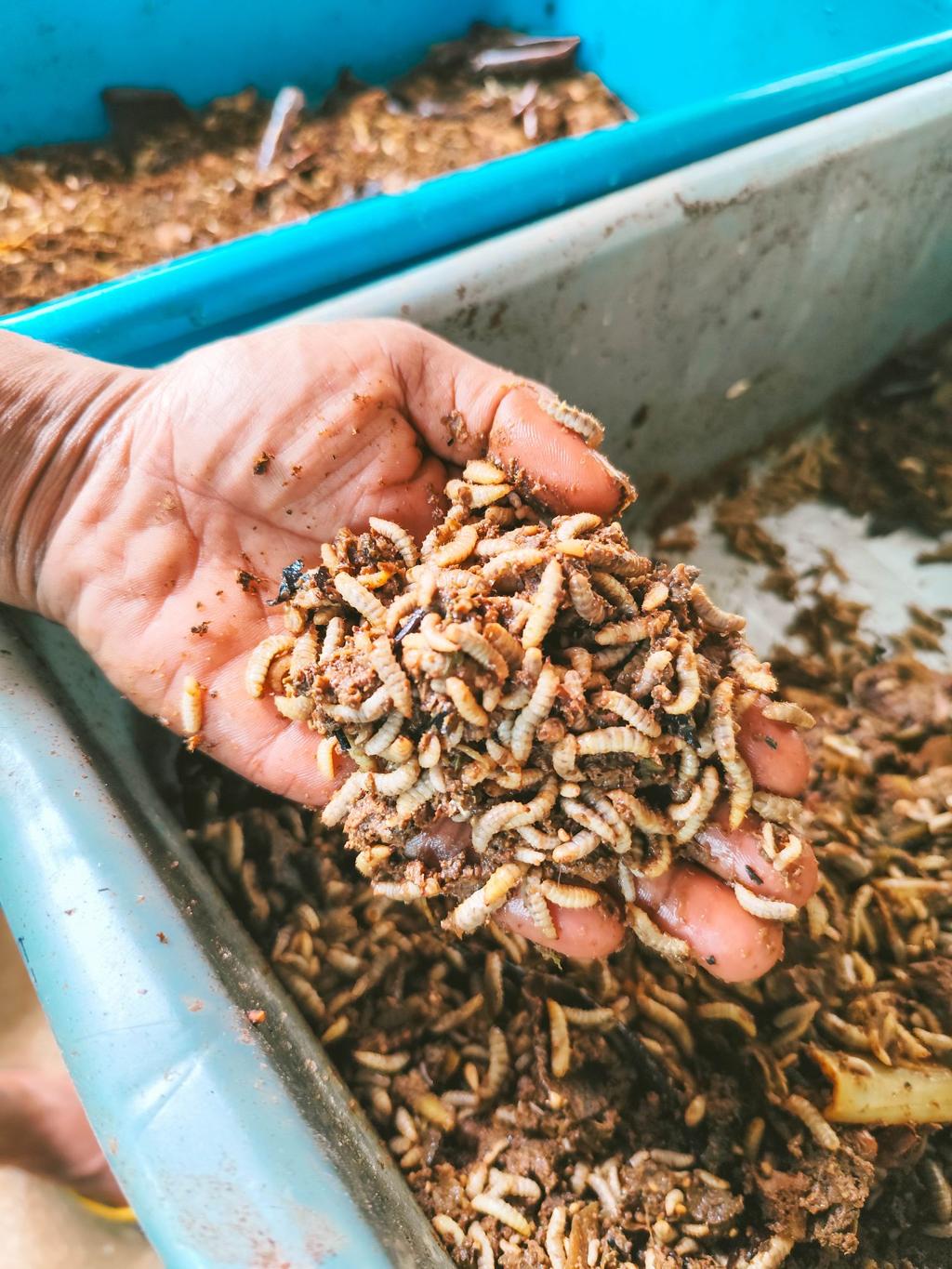
Anatomy of the BSF Larva


The larva differs greatly from the adult.
Major Larval Structures
Head Capsule
- Contains feeding mouthparts.
Mouth Hooks
- Used to consume organic materials.
Segmented Body
- Allows flexibility and movement.
Cuticle
- Tough outer covering that protects the larva.
Digestive Tract
- Efficiently processes large amounts of organic waste.
Anatomy of the BSF Pupa


During pupation:
- Larval tissues are reorganized.
- Wings develop.
- Adult organs form.
- Reproductive structures mature.
The pupa does not feed and remains relatively inactive while transformation occurs.
Distinguishing Features of BSF
Compared to Houseflies
| Black Soldier FlyHousefly | |
| Black body | Gray body |
| Long antennae | Short antennae |
| Does not feed as adult | Feeds as adult |
| Does not spread disease | Can spread disease |
| Beneficial insect | Often considered a pest |
Importance of Understanding BSF Anatomy
Knowledge of BSF anatomy helps farmers:
- Correctly identify BSF adults and larvae.
- Differentiate BSF from harmful insects.
- Improve breeding success.
- Understand feeding and reproductive behavior.
- Manage colonies more effectively.
Critical Thinking Questions
1. Why do adult BSF have non-functional mouthparts?
Answer: They rely on energy stored during the larval stage and do not need to feed.
2. How do antennae help adult BSF survive and reproduce?
Answer: They detect odors, mates, and suitable breeding locations.
3. Why are compound eyes important to BSF adults?
Answer: They help detect light, movement, and potential mates.
4. What would happen if a BSF adult had damaged wings?
Answer: Its ability to fly, mate, and locate breeding sites would be reduced.
5. Why is the thorax considered the center of movement?
Answer: It contains the wings, legs, and flight muscles.
6. How does the larval anatomy support waste conversion?
Answer: Specialized mouthparts and a powerful digestive system enable rapid feeding and digestion.
7. Why are fat reserves important in the abdomen of adult BSF?
Answer: They provide energy throughout the adult lifespan.
8. How does the segmented body benefit the larva?
Answer: It improves flexibility and movement through waste materials.
9. Why is it important for BSF farmers to distinguish BSF from houseflies?
Answer: To manage beneficial insects properly and avoid confusion with pests.
10. How does understanding BSF anatomy improve farming efficiency?
Answer: It helps farmers optimize breeding, identification, and colony management.